
A Structural Comparison of HVAC Online Pricing Systems
Online pricing has become a serious strategic decision in the HVAC industry. Homeowners expect transparency before booking appointments, and contractors are looking for ways to provide that transparency without undermining margins or creating defensive sales conversations. As a result, platforms like UpFrog and Contractor Commerce often appear in the same comparison.
Although both platforms involve publishing pricing online, they were built with very different architectural intentions. One enhances a website experience. The other is designed to generate and structure replacement demand at scale.
Understanding the distinction requires looking beyond features and examining how each platform fits into your overall revenue model.
Contractors comparing these systems are usually trying to solve bigger issues than website functionality. They are trying to:
Stabilize replacement revenue
Reduce reliance on emergency breakdown cycles
Improve appointment quality
Increase financing utilization
Align marketing with in-home sales
Build long-term enterprise value
In that context, the difference between a storefront and a growth engine becomes structural — not cosmetic.
The Core Structural Difference
At its foundation:
Contractor Commerce functions as a website-based pricing storefront.
UpFrog functions as a demand-generation and revenue-alignment engine.
A storefront improves the browsing experience for people already visiting your website. A growth engine manufactures demand before urgency exists and aligns pricing transparency with sales execution.
This difference influences:
Where buyers originate
When they enter the funnel
How expectations are framed
How predictable replacement revenue becomes
One depends on traffic already flowing to your site. The other creates traffic intentionally and guides it through a structured replacement journey.
What Contractor Commerce Was Originally Designed to Do
Contractor Commerce initially entered the HVAC market focused primarily on e-commerce functionality. Early implementations were centered around enabling contractors to sell consumable items such as HVAC filters and light accessories directly through their websites. The core value proposition was convenience — allowing contractors to monetize repeat purchases and basic product sales online.
At that stage, the platform functioned as a digital storefront layer. It enhanced existing website traffic by enabling online purchases and structured browsing for small-ticket items.
As the industry’s interest in online replacement pricing grew, market expectations shifted. Contractors began experimenting with publishing system-level pricing, and online transparency started to demonstrate measurable revenue impact in certain markets.
Over time, Contractor Commerce expanded its feature set to include broader online estimate functionality and instant pricing tools intended to support replacement conversations.
It is common in competitive software markets for platforms to evolve as buyer expectations evolve. However, original architectural intent often remains visible in how a system operates.
Contractor Commerce remains fundamentally structured as a website enhancement layer. Its foundation is rooted in converting traffic that already exists.
UpFrog, by contrast, was purpose-built around high-ticket HVAC replacement demand generation from inception. Its architecture centers on:
Manufacturing demand outside search
Introducing replacement cost awareness before urgency
Framing pricing as orientation rather than checkout
Integrating marketing and in-home sales alignment
Tracking replacement revenue attribution
While both platforms may now offer instant pricing functionality, the surrounding system design differs substantially. The distinction is not whether pricing appears online. The distinction is whether pricing lives inside a passive storefront or inside a structured growth engine built for replacement scalability.
What Contractor Commerce Is Designed to Do Today
Today, Contractor Commerce enhances contractor websites by adding pricing functionality and structured estimate flows. For contractors who already dominate organic rankings and receive strong branded search traffic, this can improve convenience and capture late-stage shoppers more effectively.
In a demand-capture environment, the platform can:
Improve conversion of existing website visitors
Provide structured browsing for in-market shoppers
Offer a product-style estimate experience
Increase website monetization efficiency
However, it operates inside an assumption: the buyer has already entered the market.
The homeowner has searched.
They have identified need.
They are comparing options.
Performance is therefore tied to:
SEO rankings
Organic click-through rates
Map pack visibility
Branded search strength
If traffic declines due to algorithm shifts or zero-click searches, storefront engagement declines accordingly. The platform enhances demand that already exists, but it does not independently create upstream replacement demand.
What UpFrog Is Designed to Do
UpFrog operates from a different premise. Many high-value HVAC replacement customers are not actively searching when the opportunity first appears. They are experiencing rising energy costs, uneven comfort, or aging equipment, but they have not entered breakdown mode.
UpFrog reaches homeowners before urgency by creating replacement awareness through paid social demand generation and structured pricing orientation.
The system integrates:
Paid social discovery campaigns
Replacement cost range education
Clear explanation of pricing variables (tonnage, efficiency, ductwork, access)
Good / Better / Best positioning
Financing normalization early in the journey
Structured qualification before the appointment
AI + human speed-to-lead follow-up
CRM and field software integration
Revenue attribution tracking
The objective is not to close online transactions. The objective is to generate new replacement customers who arrive at in-home appointments informed and aligned.
Importantly, this growth is additive. It does not siphon repair traffic or cannibalize branded SEO. It introduces homeowners who may not have otherwise entered the funnel.
Documented Revenue Performance
The difference between these models becomes more visible when measured in revenue.
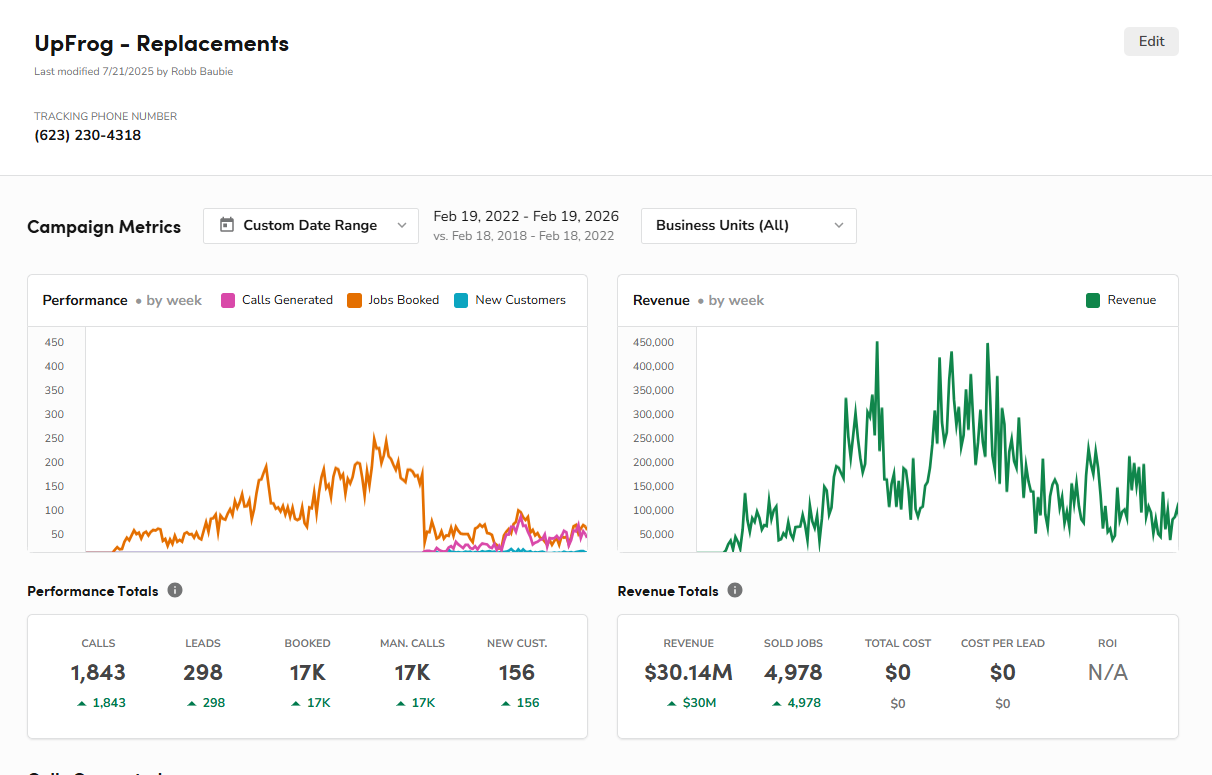
Performance dashboard reflecting tracked HVAC replacement revenue from a structured demand-generation campaign.
In one documented replacement-focused UpFrog campaign:
$30.14 million in tracked revenue
4,978 sold HVAC replacement jobs
1,843 inbound calls generated
Weekly revenue peaks exceeding $400,000
Sustained multi-year performance trend
This performance was generated through paid demand creation combined with pricing orientation and structured follow-up.
Results vary by market, operational capacity, and competitive landscape. However, documented eight-figure campaigns demonstrate that when pricing transparency is integrated into a growth engine, it can support scalable replacement revenue rather than undermine it.
Demand Capture vs Demand Creation
The contrast can be summarized as reactive versus proactive models.
Contractor Commerce (Demand Capture)
Wait for search and urgency
Compete in late-stage bid environments
Depend heavily on search visibility
Convert traffic that already exists
UpFrog (Demand Creation)
Introduce replacement awareness early
Engage before system failure
Normalize financing before urgency
Build replacement pipeline intentionally
Proactive demand creation reduces reliance on seasonal spikes and weather volatility by generating consistent awareness upstream.
The Structural Shift in Search Behavior
Search behavior has changed significantly in recent years. AI-generated summaries, pricing overviews, and “People Also Ask” panels increasingly provide informational answers directly within search results. This has led to rising zero-click searches.
In many markets, the buyer journey now looks like:
Search query
AI overview or map pack
Google Business Profile interaction
Direct phone call
Websites still play an important credibility role, but organic click share has compressed. Enhancing a website storefront does not address this broader shift.
UpFrog reduces search dependency by generating demand directly in social discovery environments, rather than waiting for shrinking organic clicks.
Side-by-Side Structural Comparison
| Category | Contractor Commerce | UpFrog |
|---|---|---|
| Core Identity | Website pricing storefront | Demand-generation growth engine |
| Traffic Source | Existing website visitors | Paid social demand creation |
| Buyer Stage | Late-stage urgency | Early & mid-stage awareness |
| Revenue Model | Captures existing demand | Creates additive replacement growth |
| Pricing Role | Display & browse | Orientation & qualification |
| Financing Framing | Limited | Integrated early |
| Lead Qualification | Minimal | Structured filtering |
| Follow-Up | Basic notifications | AI + human concierge |
| Search Dependency | High | Reduced |
| Scalability | Traffic-dependent | Systemized multi-market deployment |
Which Model Fits Your Strategy?
Contractor Commerce may be appropriate if you:
Already dominate local SEO
Primarily seek website enhancement
Focus on convenience for existing shoppers
Are satisfied with reactive growth
UpFrog is typically suited for contractors who:
Focus heavily on replacement revenue
Want predictable pipeline outside peak seasons
Seek higher-intent appointments
Operate in competitive metros
Are scaling locations
Value marketing-to-sales integration
The strategic decision is not about which platform displays pricing. It is about whether pricing functions as a passive feature or as a component inside a broader growth engine.
Frequently Asked Questions
What is the main difference between UpFrog and Contractor Commerce?
Contractor Commerce is a website-based pricing storefront that displays pricing to existing visitors. UpFrog is a demand-generation system that creates new HVAC replacement customers through paid social advertising, structured pricing orientation, and integrated follow-up.
Was Contractor Commerce originally built to sell filters?
Contractor Commerce initially focused heavily on enabling contractors to sell consumable items such as HVAC filters and light accessories through their websites. Over time, the platform expanded into broader online estimate functionality as industry expectations evolved.
Does UpFrog generate new HVAC replacement customers?
Yes. UpFrog is specifically designed to introduce replacement cost awareness before urgency, generating new customers who may not have been actively searching yet.
Does Contractor Commerce create new demand?
Contractor Commerce primarily enhances conversion of existing website visitors. It does not independently manufacture upstream demand outside of traffic the contractor already owns.
Does UpFrog depend on SEO rankings?
No. UpFrog generates demand through paid social discovery channels and does not rely solely on organic search visibility.
Why are contractor websites receiving fewer clicks?
Search engines increasingly answer informational queries directly within results pages using AI-generated summaries and pricing overviews. This has increased zero-click searches and reduced organic click-through rates in many markets.
Does online pricing reduce close rates?
Online pricing can reduce close rates if presented without context. When structured with ranges, system tiers, and financing framing, it can improve alignment and reduce friction during in-home appointments.
Does UpFrog replace in-home HVAC sales?
No. Final system validation and pricing confirmation occur during the in-home visit. UpFrog prepares homeowners before the appointment but does not eliminate the need for consultative sales.
Will UpFrog cannibalize repair traffic?
No. UpFrog targets replacement-focused homeowners and is designed to add replacement revenue rather than redistribute existing service demand.
Final Perspective
Online pricing is not the strategy. It is the tool.
The strategic decision is whether pricing functions as a passive storefront enhancement or as part of a structured demand-generation engine designed for replacement growth.
In an environment where search behavior continues to evolve and organic clicks compress, the difference between capturing traffic and creating demand becomes increasingly important.
Contractors should choose the model that aligns with the business they intend to build — not simply the feature they intend to add.