
When contractors complain about “bad leads,” they are rarely talking about people who aren’t real. They are talking about homeowners who were never aligned to buy in the first place. Appointments are booked, conversations happen, but the sale stalls. Sales teams feel resistance. Close rates suffer.
The instinctive response is to blame the traffic source, the ad platform, or the marketing agency. In reality, lead quality problems almost always originate before the lead is created — at the point where expectations are set or left undefined.
Online pricing is one of the most effective tools contractors have to improve lead quality, not by reducing demand, but by aligning it. This page explains how online pricing filters buyers naturally, why transparency improves intent, and how expectation-setting creates better conversations long before a salesperson ever gets involved.
Why “Low-Quality Leads” Are Usually an Expectation Problem
Lead quality is often treated as a traffic issue. Contractors assume that better targeting, better ads, or better keywords will magically produce more qualified buyers. While targeting matters, it does not solve the core problem.
Most low-quality leads are created when:
Homeowners do not understand the level of investment required
Buyers confuse repairs with replacements
Pricing expectations are formed inaccurately
Curiosity is mistaken for readiness
In these situations, the lead itself is not bad. The expectation is.
Online pricing addresses this root issue by orienting buyers before they ever raise their hand.
How Hidden Pricing Creates Misaligned Leads
When pricing is hidden entirely, homeowners are forced to guess. Those guesses become mental anchors that shape the entire buying conversation.
Some buyers assume projects are far cheaper than reality. Others assume they are far more expensive. Both outcomes produce misalignment.
When a lead is generated without pricing context:
The homeowner is emotionally unprepared
The sales conversation starts defensively
Price objections feel personal
Trust erodes quickly
These leads feel “low quality” because they were created without alignment, not because the homeowner was unqualified by nature.
Online pricing prevents this by replacing guesswork with context.
How Online Pricing Filters Buyers Without Force
One of the most misunderstood benefits of online pricing is self-selection.
When homeowners see realistic pricing context:
Those who cannot afford the project quietly opt out
Those who are not ready delay engagement
Those who are aligned lean in confidently
This filtering happens naturally, without aggressive qualification questions or sales pressure. Buyers make their own decision about readiness.
This is why online pricing improves lead quality without killing demand. It doesn’t push people away. It allows them to decide.
Why Fewer Leads Often Means Better Marketing
Many contractors evaluate marketing success by lead volume alone. This creates a dangerous incentive to maximize form fills at the expense of alignment.
High lead volume with low close rates feels productive but drains resources. Sales teams burn out. Appointment calendars fill with low-probability conversations. Revenue becomes unpredictable.
Online pricing often reduces raw lead volume slightly — and dramatically improves outcomes.
Better marketing produces:
Higher appointment show rates
Better sales conversations
Higher close rates
More predictable revenue
Lead quality matters more than lead count.
The Relationship Between Price Shock and Lead Quality
Price shock is one of the clearest indicators of poor lead quality. When homeowners react emotionally to pricing, it signals that expectations were never aligned.
Price shock:
Triggers defensiveness
Breaks trust
Shifts focus away from value
Extends sales cycles
Online pricing reduces price shock by introducing the concept of cost earlier. When homeowners understand the order of magnitude before an appointment, pricing discussions feel logical instead of surprising.
This shift alone improves lead quality more than most targeting changes ever could.
Why Online Pricing Improves Sales Team Perception of Lead Quality
Sales teams are often the first to recognize the impact of online pricing.
When leads arrive informed:
Conversations start calmly
Buyers ask better questions
Price objections decrease
Solutions are evaluated more rationally
Salespeople stop feeling like they are delivering bad news. Instead, they guide decisions homeowners were already prepared to make.
This is why sales teams often advocate for pricing transparency even when ownership hesitates. They feel the difference immediately.
How Online Pricing Aligns Emotional and Financial Readiness
Buying a high-ticket home service requires two forms of readiness:
Emotional readiness — acceptance that a project is needed
Financial readiness — understanding of the investment involved
Traditional marketing often addresses emotional readiness first and financial readiness last. This creates imbalance.
Online pricing aligns both earlier in the journey. Buyers who proceed do so with clearer expectations and less resistance. This alignment is what transforms lead quality.
Online Pricing vs Aggressive Qualification Tactics
Some contractors attempt to improve lead quality through aggressive qualification:
Long intake forms
Budget questions upfront
Pushy phone screening
While these methods can work, they often introduce friction and distrust.
Online pricing accomplishes qualification passively. Instead of interrogating buyers, it gives them the information they need to decide.
This approach feels respectful and professional, which improves both engagement and brand perception.
Why Online Pricing Works Across Marketing Channels
Online pricing improves lead quality regardless of traffic source.
Whether leads originate from:
Social media advertising
Search
Referrals
Organic content
Pricing context shapes buyer expectations the same way. This is why online pricing often improves close rates across all channels, not just the one that introduced the buyer.
It acts as a system-level filter, not a channel-specific tactic.
How Online Pricing Reduces Wasted Appointments
Wasted appointments are one of the most expensive operational issues contractors face. They consume time, labor, and morale.
Online pricing reduces wasted appointments by:
Filtering unrealistic budgets
Reducing no-shows
Improving commitment before scheduling
Even small improvements in appointment efficiency have outsized financial impact. Fewer wasted visits means more time spent on high-probability opportunities.
Why Online Pricing Improves Long-Term Buyer Trust
Lead quality is not just about closing the first sale. It’s about creating buyers who trust the brand.
Transparency builds credibility. Even homeowners who don’t move forward immediately remember contractors who were clear and honest.
Over time, this leads to:
Better referrals
Higher repeat business
Stronger brand reputation
Online pricing improves lead quality today and trust equity tomorrow.
Common Misconceptions About Lead Quality and Pricing
Contractors often avoid pricing transparency because of misconceptions:
“Good leads won’t care about price”
“We can qualify later in the home”
“Showing price scares people away”
In reality, good leads care deeply about price — they just want to understand it before committing time.
Online pricing respects that preference.
When Online Pricing Has the Biggest Impact on Lead Quality
Online pricing delivers the greatest lead-quality improvements when:
Projects are high-ticket
Scope varies within predictable ranges
Buyers research before calling
Sales teams handle multiple options
In these environments, expectation-setting matters more than urgency.
This is why online pricing is especially powerful in replacement-driven trades.
How Online Pricing Fits Into a Modern Lead-Generation System
Online pricing is not a standalone fix. It works best when combined with:
Education
Demand creation
Clear messaging
Sales alignment
Together, these elements create a system that attracts fewer, better buyers instead of more misaligned ones.
This is the core philosophy behind online pricing for contractors as a growth strategy.
Final Thoughts on Online Pricing and Lead Quality
Online pricing improves lead quality because it replaces uncertainty with clarity.
It filters buyers naturally, reduces surprise, and aligns expectations before a conversation ever begins. The result is not fewer opportunities — it is better ones.
Contractors who adopt pricing transparency stop asking, “Why are these leads so bad?” and start asking, “Why didn’t we do this sooner?”
How HVAC Buyers Actually Make Decisions
Replacing an HVAC system is not an impulse purchase. It’s one of the largest investments a homeowner makes, and it’s driven by a mix of comfort, cost, timing, and trust. Unlike emergency repairs, replacement decisions are often delayed, researched, and discussed internally before action is taken.
Social media advertising works for HVAC because it reaches homeowners during this consideration phase — when they’re open to learning, comparing options, and planning financially. When ads educate instead of pressure, they create familiarity and trust long before the first appointment is scheduled.
The contractors who win in this environment are the ones who guide the buyer journey rather than chasing it.
Why Most HVAC Social Media Ads Underperform
Many HVAC social media campaigns fail because they’re built around the wrong objective. Agencies optimize for clicks and form fills, while contractors need sold installations and profitable replacements. This disconnect creates predictable problems.
Generic lead forms attract homeowners with no budget context. Ads hide pricing entirely. Call centers book appointments with unrealistic expectations. Sales teams walk into homes already fighting skepticism and sticker shock.
When this happens, the platform gets blamed — but the platform isn’t the problem. The system is.
What High-Performing HVAC Social Media Advertising Looks Like
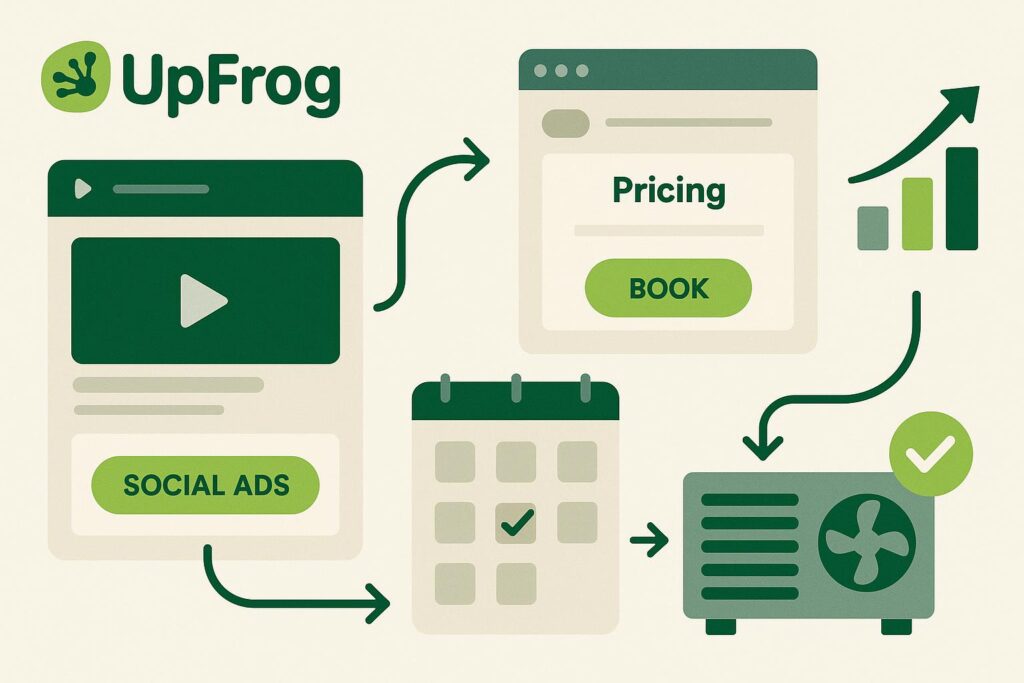
Successful HVAC social media advertising focuses on planned demand, not panic. Instead of waiting for systems to break, campaigns speak to homeowners who are already thinking about replacement — even if they haven’t said it out loud yet.
Messaging emphasizes comfort, efficiency, long-term savings, and financing options rather than discounts or urgency. Ads frame replacement as a proactive decision instead of a forced one.
Most importantly, high-performing campaigns set expectations early. They don’t hide the reality of pricing — they introduce it responsibly, creating clarity instead of friction.
Platforms That Work Best for HVAC Social Media Advertising
Facebook and Instagram remain the strongest platforms for HVAC advertising because they combine reach, targeting, and education in one environment. These platforms allow contractors to introduce replacement concepts, financing options, and seasonal messaging to homeowners who are not actively searching yet.
Video and short-form content play a supporting role by building trust and authority. Educational videos explaining system lifespan, efficiency ratings, and replacement timing help homeowners feel informed rather than sold.
Retargeting reinforces these messages, keeping the contractor top-of-mind as the homeowner moves closer to a decision.
The key is not using every platform — it’s using the right platforms with the right intent.
The Role of Pricing Transparency in HVAC Social Media Ads
HVAC pricing is one of the biggest friction points in marketing. When price is hidden completely, homeowners fill out forms without understanding the investment, leading to disappointment and low close rates.
When pricing context is introduced early — through ranges, examples, or financing framing — several things happen. Unrealistic budgets self-filter out. Serious buyers lean in. Sales conversations shift from justification to selection.
Pricing transparency does not eliminate in-home sales. It makes them more effective. Social media advertising that incorporates pricing awareness consistently produces higher-quality appointments and stronger close rates.
Who HVAC Social Media Advertising Works Best For
This approach works best for HVAC contractors who focus on system replacement and upgrades rather than repair-only volume. It favors companies that offer financing, care about long-term growth, and want predictable install demand instead of seasonal chaos.
It is especially effective for owners who want marketing that supports sales teams instead of overwhelming them. When expectations are aligned before the appointment, sales performance improves without additional pressure.
This model is not designed for contractors chasing the cheapest leads or relying exclusively on breakdown calls. It’s built for businesses that want stability, margin, and scale.
How a Revenue-Driven HVAC Social Media System Works
Every effective HVAC campaign starts with understanding the market. Pricing, financing options, install capacity, and sales process all influence how ads should be structured. Without this alignment, optimization becomes guesswork.
Campaigns are then built around replacement demand, seasonal timing, and homeowner education. Ads speak to common problems and future planning rather than immediate emergencies.
Traffic flows into conversion systems that set expectations early. These systems qualify homeowners before appointments are booked, reducing wasted time and improving sales efficiency.
Once live, optimization focuses on booked installs and sold jobs — not just lead volume. Sales feedback drives improvement, allowing campaigns to compound instead of reset.
HVAC Social Media Advertising vs Traditional HVAC Marketing
Traditional HVAC marketing is reactive. It waits for systems to fail and competes aggressively on urgency. Social media advertising, when done correctly, is proactive. It creates demand before failure and builds trust over time.
Where traditional marketing produces spikes, social media systems create consistency. Where panic marketing burns out teams, expectation-driven campaigns improve morale and close rates.
The difference isn’t creative. It’s strategy.
Why HVAC Contractors Choose This Model
HVAC contractors move to this approach when they realize that more leads do not equal more revenue. They want marketing that understands how systems are sold, how homeowners think, and how sales teams perform.
They choose systems over tactics, clarity over volume, and predictability over chaos.
Social media advertising becomes a growth engine when it’s built around revenue — not just activity.
What to Do Next
If you’re evaluating social media advertising for your HVAC business, the real question isn’t whether ads can generate leads. It’s whether your marketing system can turn attention into sold installations without burning out your team.
Learn how pricing transparency improves conversion, explore how social media advertising works across other trades, or review real-world examples of revenue-driven campaigns in action.
When HVAC social media advertising is built correctly, it doesn’t just fill the calendar.
It builds the business.