
The Only 3 Facebook Ads HVAC Companies Will Ever Need
Most HVAC companies fail with Facebook advertising for one simple reason: they try to make one ad do everything.
They want a single ad to educate the homeowner, create urgency, explain pricing, generate a lead, and close the sale — all at once. When that doesn’t happen, the conclusion is predictable: Facebook ads don’t work for HVAC.
In reality, Facebook ads work extremely well for HVAC companies — but only when they are used as part of a system, not as standalone tactics. That system does not require dozens of ads, endless creative testing, or complicated funnels. It requires three specific ad types, each with a clearly defined role.
This page explains why only three Facebook ad types matter for HVAC companies, what role each plays in the system, when each one works best, and why most HVAC ads fail by trying to collapse all three into one.
Why Most HVAC Facebook Ads Fail
Facebook ads work extremely well for HVAC companies when they are treated as part of a system rather than isolated offers. This is the foundation of HVAC social media advertising, where demand creation, expectation setting, and reinforcement each play a distinct role.
Instead of matching the homeowner’s stage in the buying journey, they attempt to force a decision immediately. The ad asks for an appointment before the homeowner understands the problem. It asks for a commitment before pricing expectations exist. It pushes urgency onto people who are still researching.
This creates three common outcomes:
- High engagement but low-quality leads
- Appointments that stall after the visit
- Sales conversations dominated by price shock
The issue is not Facebook. The issue is misaligned intent.
HVAC replacement is rarely an impulse decision. It is a planned, high-trust, high-investment choice. When ads ignore that reality, performance suffers.
The Core Principle: One Ad, One Job
The reason only three ad types matter is simple: each ad should do one job well.
Trying to combine education, pricing, urgency, and conversion into a single message overwhelms the homeowner and confuses the algorithm. Facebook’s delivery system works best when the message is clear, focused, and aligned to where the buyer actually is.
When HVAC companies separate their ads by role instead of by offer, results stabilize.
The three ad types that consistently work are:
- A low-cost tune-up offer to attract attention and start conversations
- A “find out what a new HVAC system costs” ad to set expectations and prepare replacement buyers
- A giveaway or incentive ad to reinforce trust and re-engage undecided homeowners
Each ad exists for a different moment in the decision process.
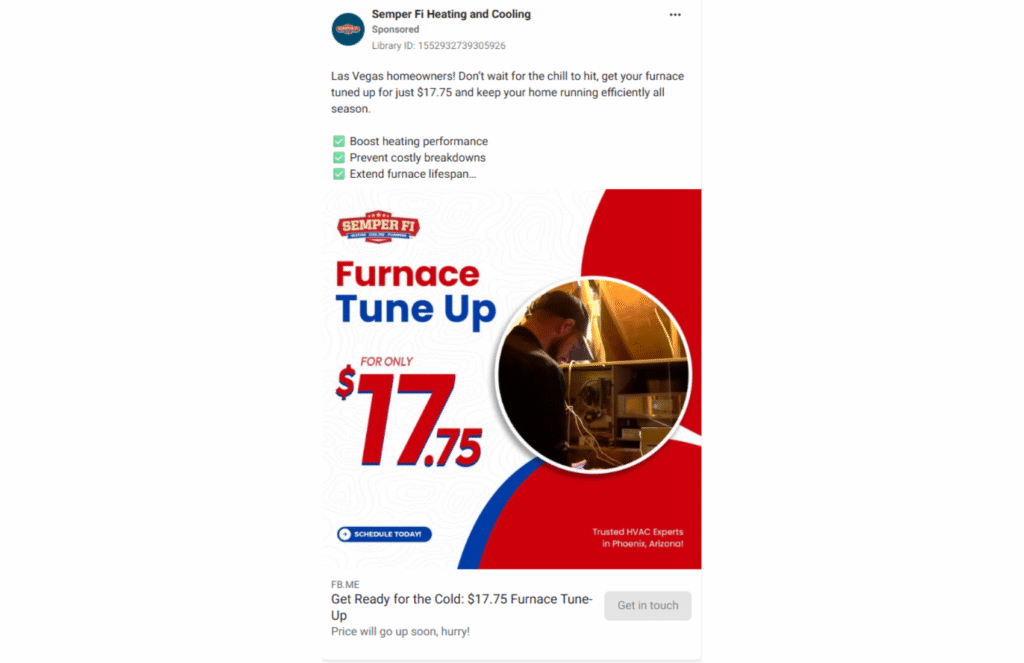
Ad #1: The Low-Cost Tune-Up Offer ($17–$49)
The low-cost tune-up ad is the entry point into the system. Its job is not to sell replacement. Its job is to reduce friction and get homeowners to raise their hand.
Offers in the $17–$49 range work because they feel safe. They do not require trust upfront. They do not trigger defensive pricing thoughts. They give homeowners a reason to engage without committing to a larger decision.
This ad works best because it aligns with how homeowners already think:
- “Let’s just have someone look at it.”
- “We should get this checked before summer/winter.”
- “At least we’ll know where we stand.”
The tune-up ad attracts attention and volume, but that is not the end goal. It is the beginning of the relationship.
When this ad works best
- At the top of the funnel
- During shoulder seasons
- When homeowners are not yet thinking about replacement
- When trust has not been established
What this ad should not do
- Talk about replacement pricing
- Push urgency
- Try to pre-sell a system
Its role is access, not conversion.
Why Tune-Up Ads Fail When Used Alone
Many HVAC companies stop at the tune-up ad and assume replacement sales should follow naturally. When that doesn’t happen, they blame lead quality.
The problem is that tune-up ads attract maintenance-minded buyers, not replacement-ready buyers. Without additional expectation setting, homeowners move from tune-up to in-home visit still assuming a small outcome.
This is why tune-up ads must be followed by a second ad type — one that prepares the homeowner for the possibility of replacement.
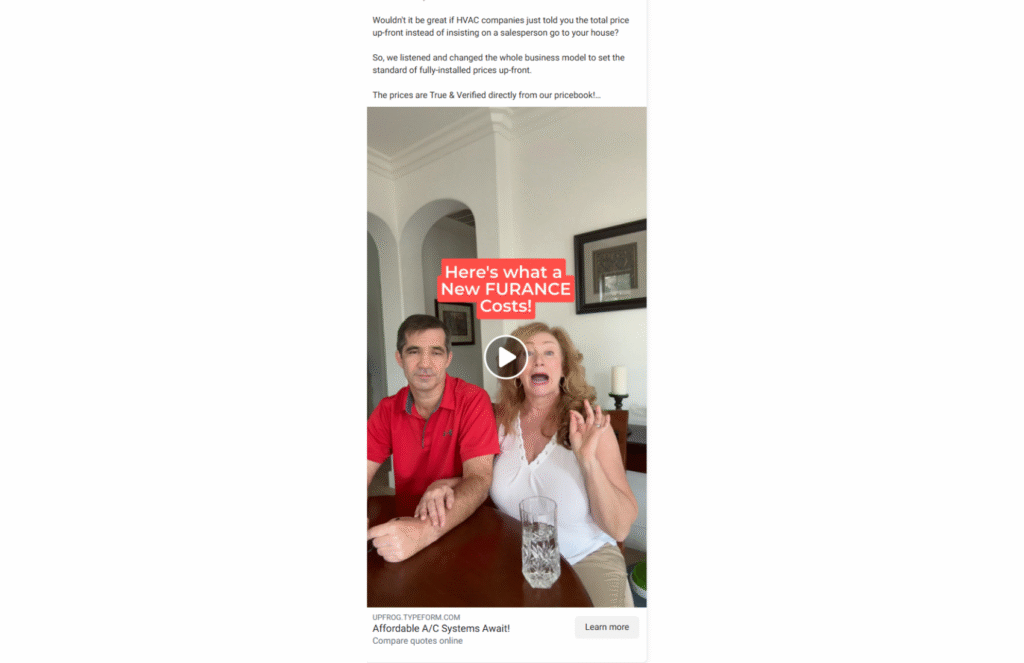
Ad #2: “Find Out What a New HVAC System Costs”
This is the most important ad in the entire system — and the one most HVAC companies are afraid to run.
The “find out what a new HVAC system costs” ad does not sell a system. It sets context. It gives homeowners permission to explore pricing without pressure and without embarrassment.
Instead of hiding pricing until the appointment, this ad introduces the idea that replacement is a known, understandable investment, not a mystery.
This is why pricing-context ads are so effective. By introducing cost expectations before the appointment, homeowners arrive prepared rather than surprised. This approach is rooted in pricing transparency in HVAC advertising, which reduces friction and improves close rates without pushing exact numbers.
This ad reframes the decision from:
“How bad is this going to be?”
to:
“What does replacement usually look like?”
When this ad works best
- For homeowners with older systems
- For people who engaged with tune-up or educational content
- For replacement-curious buyers who are researching quietly
Why this ad improves sales
- It reduces price shock
- It filters unrealistic expectations
- It prepares homeowners emotionally and financially
This is not an instant quote ad. It is an expectation-setting ad.
Why Pricing Context Is the Difference Between Leads and Decisions
Most HVAC replacement sales stall not because of price, but because of surprise.
When pricing context is introduced before the appointment, conversations change. Homeowners ask better questions. Sales feels calmer. Decisions happen faster.
This is why the pricing-context ad should exist before the in-home visit, not during it.
When HVAC companies skip this ad, sales teams inherit the problem later.
Ad #3: The Giveaway or Incentive Ad
The giveaway ad is not about the prize. It is about re-engagement and reinforcement.
This ad works on homeowners who:
- Didn’t book after the first interaction
- Booked but didn’t decide
- Are still watching and comparing
The giveaway creates a reason to re-enter the conversation without pressure.
Common examples include:
- Seasonal giveaways
- Equipment credits
- Service upgrades
- Maintenance bundles
The value is not the incentive itself — it is the reminder.
When this ad works best
- As retargeting
- After tune-up or pricing engagement
- When decisions are delayed
This ad exists to keep your brand top-of-mind while the homeowner decides.

Why Most HVAC Ads Fail by Trying to Do Too Much
Most HVAC Facebook ads fail because they attempt to combine all three roles into one message.
They:
- Offer a tune-up
- Mention replacement
- Hint at pricing
- Push urgency
- Ask for an appointment
This confuses both the homeowner and the algorithm.
Homeowners don’t know what they’re being asked to do. Facebook doesn’t know who to show the ad to. Performance becomes inconsistent.
When each ad has a single role, results stabilize.
How the Three Ads Work Together as a System
The system works because it mirrors how homeowners actually make decisions.
- Tune-up ad → lowers friction and starts engagement
- Pricing-context ad → prepares and qualifies replacement interest
- Giveaway ad → reinforces trust and nudges undecided buyers
No single ad closes the deal. The system does.
This approach reduces wasted appointments, improves lead quality, and makes sales conversations easier instead of harder.
Why You Don’t Need More Than These Three Ads
HVAC companies often assume performance issues mean they need more complexity. In reality, they usually need less.
When these three ads are present:
- You cover every stage of the buyer journey
- You reduce pressure on sales teams
- You stop relying on urgency alone
- You create predictable replacement demand
More ads don’t fix broken systems. Clear roles do.
Final Takeaway: Facebook Ads Work When They Respect the Buying Cycle
Facebook is not a lead machine. It is a decision-shaping platform.
HVAC companies that treat it like a one-click sales channel get inconsistent results. HVAC companies that use it to guide homeowners through a logical progression see stable performance and higher-quality outcomes.
You don’t need endless ad ideas.
You need the right three ads, doing the right jobs, in the right order.
That’s how Facebook ads stop feeling unpredictable — and start supporting real HVAC replacement growth.