
Online pricing is often misunderstood in the contractor world. Some see it as a shortcut that removes the need for sales. Others view it as a dangerous transparency play that invites price shopping and erodes margins. Both interpretations miss the point.
Online pricing is not about selling projects without human interaction. It is not about publishing fixed prices and hoping homeowners buy on their own. It is a system for setting expectations earlier in the buyer journey, long before a contractor ever steps into a home.
This page explains how online pricing actually works for contractors, why it improves performance instead of hurting it, and how pricing transparency integrates into modern demand-generation systems like social media advertising.
Online Pricing Is an Expectation-Setting System, Not a Checkout Button
The most important concept to understand is this: online pricing does not replace the sales process. It improves it.
Traditional contractor sales rely heavily on surprise. Homeowners often enter appointments with little understanding of cost, scope, or options. Sales conversations begin defensively, with pricing revealed late and objections handled emotionally.
Online pricing flips this dynamic.
Instead of hiding the investment until the last moment, online pricing introduces context earlier. Homeowners gain a general understanding of what projects cost, why prices vary, and what factors influence final numbers. This orientation changes the entire tone of the conversation.
That expectation-setting role is why online pricing is so closely tied to pricing transparency and why it performs best when paired with education.
Where Online Pricing Fits in the Modern Buyer Journey
Homeowners do not move directly from awareness to purchase. Especially for high-ticket home services, decisions unfold in stages.
Most buyers progress through:
Problem recognition
Information gathering
Option comparison
Budget orientation
Commitment
Traditional marketing skips steps four and five until the very end. Online pricing inserts itself at the budget-orientation stage, before a commitment is made but after curiosity has formed.
This placement is critical.
When homeowners understand the general investment level early, they self-qualify emotionally and financially. Those who proceed do so with intent. Those who aren’t ready opt out without friction.
This is how online pricing improves outcomes without reducing demand.
Why Contractors Hide Pricing — and Why It Backfires
Contractors hide pricing for understandable reasons:
Every job is different
Final cost depends on in-home conditions
Fear of price shopping
Fear of sticker shock
The problem is that hiding pricing doesn’t eliminate these issues — it magnifies them.
When no pricing context is provided, homeowners create their own assumptions. Those assumptions are rarely accurate. Some drastically underestimate cost. Others overestimate and delay engagement entirely.
By the time a sales conversation happens, expectations are already misaligned.
Online pricing prevents this by anchoring expectations realistically before assumptions harden.
This is why pricing transparency is foundational to online pricing for contractors, not optional.
What Online Pricing Looks Like in Practice
Online pricing does not require exact numbers. In fact, publishing rigid prices often creates more problems than it solves.
Effective online pricing uses structured context, such as:
Price ranges instead of fixed prices
Good / Better / Best option frameworks
Example scenarios with explanations
Financing illustrations
Upgrade and add-on pathways
The goal is not to finalize pricing online. The goal is to eliminate surprise.
When homeowners understand the order of magnitude of a project, conversations become calmer, more productive, and more honest.
This is the difference between transparency and oversharing.
How Online Pricing Improves Lead Quality Automatically
One of the most powerful benefits of online pricing is that it filters leads without force.
When pricing context is visible:
Unrealistic budgets self-filter out
Curious but unready buyers delay engagement
Serious buyers lean in with confidence
This self-selection process improves lead quality without aggressive qualification tactics. It also reduces wasted appointments and improves sales morale.
Importantly, this does not reduce overall demand. It refines it.
This is why online pricing pairs so effectively with social media advertising for contractors, where buyers are reached earlier in the decision cycle and benefit from clarity before urgency.
Why Online Pricing Works Especially Well with Social Media Advertising
Social media advertising introduces ideas before urgency exists. These buyers are not in crisis mode. They are cautious, curious, and information-seeking.
When social ads drive traffic into pricing-aware experiences:
Trust increases
Engagement improves
Lead quality rises
Close rates follow
Without pricing context, social media ads generate attention without alignment. With pricing context, they generate readiness.
This relationship is why online pricing is a core component of modern demand-generation systems — not a standalone tactic.
Online Pricing Does Not Eliminate In-Home Sales
A common fear is that online pricing removes the need for salespeople. In reality, it makes salespeople more effective.
Online pricing prepares the homeowner. In-home sales still handle:
Site-specific variables
Custom solutions
Final scope confirmation
Trust and rapport
The difference is that sales conversations start at a higher level. Instead of explaining why prices are what they are, reps focus on helping homeowners choose the right option.
Online pricing doesn’t close deals.
It removes friction so deals can close naturally.
Why Online Pricing Does Not Create a Race to the Bottom
Commoditization happens when price is shown without explanation.
Online pricing systems avoid this by pairing pricing with value. They explain why costs vary, what influences price, and how different choices affect outcomes.
When homeowners understand why something costs what it does, they compare differently. Trust becomes more important than price alone.
This is why online pricing, when implemented correctly, actually strengthens differentiation instead of weakening it.
How Online Pricing Improves Sales Team Performance
Sales teams experience the benefits of online pricing immediately.
When homeowners arrive informed:
Fewer conversations start defensively
Price objections decrease
Sales cycles shorten
Confidence improves
Sales morale increases because reps stop delivering surprises. Instead, they guide decisions homeowners were already prepared to make.
This alignment between marketing and sales is one of the most underappreciated advantages of online pricing.
Common Mistakes Contractors Make with Online Pricing
Online pricing fails when it is implemented incorrectly.
Common mistakes include:
Publishing exact prices without context
Using outdated or unrealistic ranges
Hiding add-ons and upgrades
Treating pricing as a lead hook
Failing to explain variability
These mistakes do not mean online pricing doesn’t work. They confirm the need for structure and education.
Online pricing succeeds when it is intentional, explanatory, and integrated into the full buyer journey.
How Online Pricing Differs by Trade
Online pricing must be contextualized by trade.
HVAC pricing must account for equipment, efficiency, and installation complexity.
Roofing pricing must consider insurance, materials, and scope variability.
Garage door pricing must address safety, materials, and upgrade paths.
This is why online pricing systems should never be copied blindly across trades. The system stays consistent; the context changes.
Understanding this nuance reinforces why online pricing for contractors is a framework, not a template.
How Online Pricing Fits into a Full Contractor Marketing System
Online pricing is not a standalone feature. It is one component of a larger system that includes:
Demand creation
Education
Pricing context
Qualification
Sales alignment
When these elements work together, marketing becomes predictable. Online pricing acts as the bridge between attention and action.
This is why contractors who adopt online pricing correctly see improvements across channels — not just on pricing pages.
What Contractors Should Expect After Implementing Online Pricing
Contractors who implement online pricing thoughtfully typically experience:
Higher quality leads
Improved close rates
Shorter sales cycles
Fewer cancellations
Better sales morale
Lead volume may change. Revenue quality improves.
Online pricing optimizes for alignment, not clicks.
Final Thoughts on How Online Pricing Works
Online pricing works because it replaces uncertainty with clarity.
When contractors stop hiding pricing and start explaining it, trust increases, conversations improve, and sales outcomes follow. Transparency does not weaken positioning — it strengthens it when paired with education and context.
Online pricing is not about giving away leverage.
It’s about earning confidence earlier.
How HVAC Buyers Actually Make Decisions
Replacing an HVAC system is not an impulse purchase. It’s one of the largest investments a homeowner makes, and it’s driven by a mix of comfort, cost, timing, and trust. Unlike emergency repairs, replacement decisions are often delayed, researched, and discussed internally before action is taken.
Social media advertising works for HVAC because it reaches homeowners during this consideration phase — when they’re open to learning, comparing options, and planning financially. When ads educate instead of pressure, they create familiarity and trust long before the first appointment is scheduled.
The contractors who win in this environment are the ones who guide the buyer journey rather than chasing it.
Why Most HVAC Social Media Ads Underperform
Many HVAC social media campaigns fail because they’re built around the wrong objective. Agencies optimize for clicks and form fills, while contractors need sold installations and profitable replacements. This disconnect creates predictable problems.
Generic lead forms attract homeowners with no budget context. Ads hide pricing entirely. Call centers book appointments with unrealistic expectations. Sales teams walk into homes already fighting skepticism and sticker shock.
When this happens, the platform gets blamed — but the platform isn’t the problem. The system is.
What High-Performing HVAC Social Media Advertising Looks Like
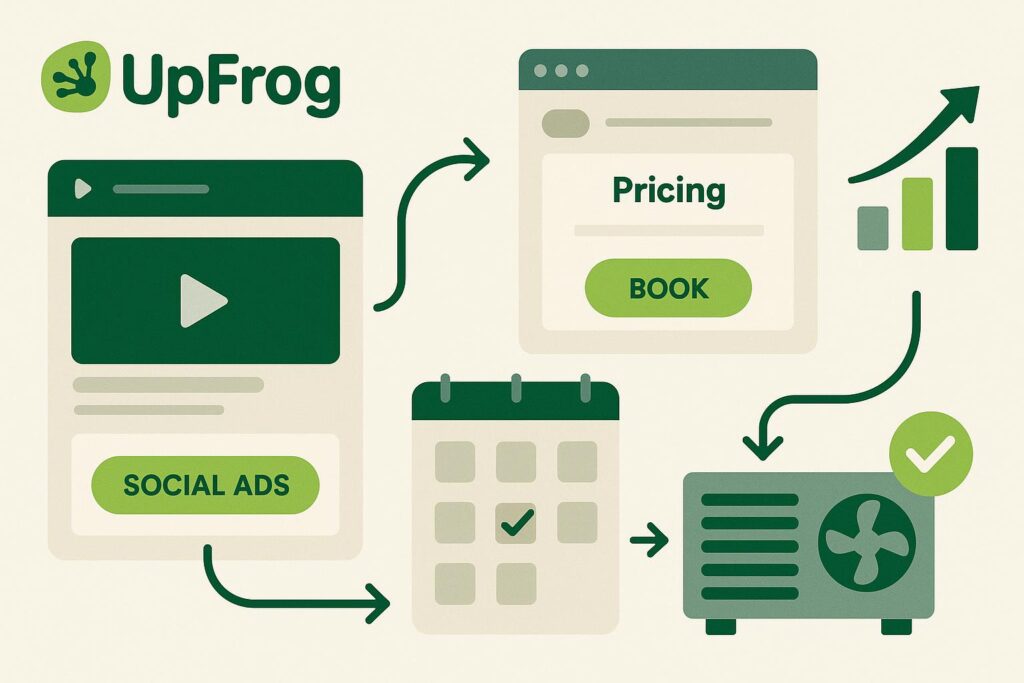
Successful HVAC social media advertising focuses on planned demand, not panic. Instead of waiting for systems to break, campaigns speak to homeowners who are already thinking about replacement — even if they haven’t said it out loud yet.
Messaging emphasizes comfort, efficiency, long-term savings, and financing options rather than discounts or urgency. Ads frame replacement as a proactive decision instead of a forced one.
Most importantly, high-performing campaigns set expectations early. They don’t hide the reality of pricing — they introduce it responsibly, creating clarity instead of friction.
Platforms That Work Best for HVAC Social Media Advertising
Facebook and Instagram remain the strongest platforms for HVAC advertising because they combine reach, targeting, and education in one environment. These platforms allow contractors to introduce replacement concepts, financing options, and seasonal messaging to homeowners who are not actively searching yet.
Video and short-form content play a supporting role by building trust and authority. Educational videos explaining system lifespan, efficiency ratings, and replacement timing help homeowners feel informed rather than sold.
Retargeting reinforces these messages, keeping the contractor top-of-mind as the homeowner moves closer to a decision.
The key is not using every platform — it’s using the right platforms with the right intent.
The Role of Pricing Transparency in HVAC Social Media Ads
HVAC pricing is one of the biggest friction points in marketing. When price is hidden completely, homeowners fill out forms without understanding the investment, leading to disappointment and low close rates.
When pricing context is introduced early — through ranges, examples, or financing framing — several things happen. Unrealistic budgets self-filter out. Serious buyers lean in. Sales conversations shift from justification to selection.
Pricing transparency does not eliminate in-home sales. It makes them more effective. Social media advertising that incorporates pricing awareness consistently produces higher-quality appointments and stronger close rates.
Who HVAC Social Media Advertising Works Best For
This approach works best for HVAC contractors who focus on system replacement and upgrades rather than repair-only volume. It favors companies that offer financing, care about long-term growth, and want predictable install demand instead of seasonal chaos.
It is especially effective for owners who want marketing that supports sales teams instead of overwhelming them. When expectations are aligned before the appointment, sales performance improves without additional pressure.
This model is not designed for contractors chasing the cheapest leads or relying exclusively on breakdown calls. It’s built for businesses that want stability, margin, and scale.
How a Revenue-Driven HVAC Social Media System Works
Every effective HVAC campaign starts with understanding the market. Pricing, financing options, install capacity, and sales process all influence how ads should be structured. Without this alignment, optimization becomes guesswork.
Campaigns are then built around replacement demand, seasonal timing, and homeowner education. Ads speak to common problems and future planning rather than immediate emergencies.
Traffic flows into conversion systems that set expectations early. These systems qualify homeowners before appointments are booked, reducing wasted time and improving sales efficiency.
Once live, optimization focuses on booked installs and sold jobs — not just lead volume. Sales feedback drives improvement, allowing campaigns to compound instead of reset.
HVAC Social Media Advertising vs Traditional HVAC Marketing
Traditional HVAC marketing is reactive. It waits for systems to fail and competes aggressively on urgency. Social media advertising, when done correctly, is proactive. It creates demand before failure and builds trust over time.
Where traditional marketing produces spikes, social media systems create consistency. Where panic marketing burns out teams, expectation-driven campaigns improve morale and close rates.
The difference isn’t creative. It’s strategy.
Why HVAC Contractors Choose This Model
HVAC contractors move to this approach when they realize that more leads do not equal more revenue. They want marketing that understands how systems are sold, how homeowners think, and how sales teams perform.
They choose systems over tactics, clarity over volume, and predictability over chaos.
Social media advertising becomes a growth engine when it’s built around revenue — not just activity.
What to Do Next
If you’re evaluating social media advertising for your HVAC business, the real question isn’t whether ads can generate leads. It’s whether your marketing system can turn attention into sold installations without burning out your team.
Learn how pricing transparency improves conversion, explore how social media advertising works across other trades, or review real-world examples of revenue-driven campaigns in action.
When HVAC social media advertising is built correctly, it doesn’t just fill the calendar.
It builds the business.