
Does Showing Prices Hurt Contractor Sales?
Built specifically for home-service contractors generating $5M–$50M annually
Does Showing Prices Hurt Contractor Sales?
For many contractors, the idea of showing prices online feels risky. Pricing has traditionally been guarded closely, revealed only after an in-home visit, detailed evaluation, and carefully structured sales conversation. The fear is understandable: show the price too early and you scare buyers away, invite price shopping, or weaken your negotiating position.
This concern is so common that it has become accepted wisdom in the trades. Contractors are told that homeowners will fixate on price, that transparency commoditizes services, and that withholding pricing preserves leverage.
Yet when examined closely, this belief does not hold up to how modern buyers actually behave.
This page examines whether showing prices hurts contractor sales, why pricing transparency often improves close rates instead of hurting them, and how expectation setting changes buyer psychology long before a sales conversation begins.
Why Contractors Believe Showing Prices Hurts Sales
The belief that pricing transparency damages sales is rooted in decades of traditional selling practices. Contractors learned to control information carefully, revealing price only after demonstrating value and diagnosing the job in person.
Several fears reinforce this mindset:
Homeowners will compare prices without understanding differences
Price shoppers will waste time
High prices will scare people away
Competitors will undercut published numbers
Each of these fears feels logical. Unfortunately, they focus on contractor behavior, not buyer behavior.
What matters is not how contractors prefer to sell, but how homeowners prefer to buy.
How Homeowners Actually React to Hidden Pricing
When pricing is hidden entirely, homeowners do not become more flexible or trusting. They become uncertain.
Modern buyers research extensively before making high-ticket decisions. When they encounter a contractor who provides no pricing context at all, they don’t assume fairness — they assume risk.
Common homeowner reactions include:
“This is probably more expensive than I can afford.”
“They’ll tell me later once I’m invested.”
“Why won’t they even give me a range?”
This uncertainty creates friction before a conversation ever happens. Some homeowners disengage quietly. Others move forward defensively, preparing themselves for bad news.
In both cases, trust is weakened — not strengthened — by hidden pricing.
The Real Cause of Price Objections
Price objections are often blamed on transparency, but they are rarely caused by price itself. They are caused by surprise.
When homeowners enter a sales conversation with unrealistic expectations, the moment pricing is revealed feels like a shock. Even reasonable prices feel expensive when they violate expectations.
This is why objections feel emotional rather than logical. The homeowner isn’t reacting to the number — they’re reacting to the gap between what they expected and what they were told.
Showing pricing context earlier reduces that gap.
Why Showing Prices Early Changes the Sales Conversation
When pricing context is introduced earlier in the buyer journey, the sales conversation starts in a very different place.
Instead of:
“Why is this so expensive?”
The conversation becomes:
“Which option makes the most sense for our situation?”
This shift is subtle but powerful. It moves the discussion from justification to selection. Sales conversations feel collaborative instead of adversarial.
Showing prices does not eliminate objections. It relocates them to a point in the journey where they are easier to address and less emotionally charged.
Price Transparency vs Exact Pricing (A Critical Distinction)
One of the biggest misunderstandings around pricing transparency is the assumption that it means publishing exact prices.
In reality, effective transparency is about context, not precision.
Transparency can include:
Price ranges
Example scenarios
Option tiers (good / better / best)
Financing illustrations
Explanations of what drives cost differences
Exact pricing is rarely appropriate online for contractors. Contextual pricing, however, is essential.
This distinction is why modern online pricing for contractors works when traditional price posting failed.
Does Showing Prices Increase Price Shopping?
Price shopping thrives in environments where pricing feels arbitrary or unexplained.
When homeowners see a single number with no context, they compare it aggressively. When they understand why prices vary, how options differ, and what affects cost, comparisons change.
Transparent pricing with explanation:
Reduces suspicion
Highlights value differences
Shifts focus away from “cheapest”
Encourages trust-based decisions
In practice, contractors who explain pricing early often experience less price shopping, not more.
Why Hiding Prices Often Hurts Close Rates
Hiding pricing does not preserve leverage. It postpones resistance.
When homeowners are surprised late in the process:
Trust erodes
Defensiveness increases
Sales cycles lengthen
Close rates suffer
Sales teams are forced to overcome emotional objections rather than logical ones. This makes closing harder, not easier.
Transparency aligns expectations earlier, allowing sales conversations to stay rational and productive.
How Showing Prices Filters Leads (Without Killing Demand)
One of the biggest concerns contractors have is that showing prices will reduce lead volume.
This is often true — and it’s usually a good thing.
Pricing context allows:
Unrealistic budgets to self-filter out
Serious buyers to lean in
Conversations to become more honest
Fewer leads does not mean worse marketing. It often means better alignment.
Contractors who evaluate success based solely on lead count miss this distinction. Revenue quality matters more than raw volume.
Why Sales Teams Prefer Pricing Transparency (Even If Owners Don’t)
Sales teams often experience the benefits of pricing transparency before ownership does.
When homeowners arrive informed:
Fewer conversations start defensively
Less time is spent justifying price
More time is spent on solutions
Close rates feel more consistent
Sales morale improves because reps stop delivering surprises. Instead, they guide decisions buyers were already prepared to make.
This operational benefit is one of the strongest arguments for transparency.
The Myth of “We’re Too Expensive to Show Prices”
Many contractors avoid pricing transparency because they believe their prices are “too high” to show online.
In reality, higher-priced contractors benefit the most from transparency — when it’s contextualized.
Premium pricing without explanation feels risky. Premium pricing with explanation feels justified.
Transparency allows higher-end contractors to:
Explain craftsmanship
Highlight long-term value
Frame price as investment
Differentiate on quality
Hiding pricing makes premium services look arbitrary. Explaining pricing makes them defensible.
How Showing Prices Improves Long-Term Brand Trust
Trust is built through consistency and honesty. When contractors are transparent about pricing philosophy early, homeowners perceive them as more credible — even if they don’t buy immediately.
Over time, this transparency compounds:
Brand reputation improves
Referrals feel safer
Repeat customers increase
Sales resistance decreases
Showing prices is not just a conversion tactic. It’s a trust strategy.
Common Mistakes That Make Pricing Transparency Fail
Pricing transparency can hurt sales when it’s implemented poorly.
Common mistakes include:
Showing exact prices without explanation
Publishing outdated ranges
Failing to explain variability
Using pricing as clickbait
Avoiding follow-up education
These failures do not prove transparency is harmful. They prove it must be structured and intentional.
When It Might Make Sense Not to Show Prices
There are limited situations where online pricing context may need to be handled carefully:
Highly specialized custom projects
Extreme scope variability without common patterns
Regulatory or compliance constraints
Even in these cases, some context is almost always better than none. Transparency does not have to be numerical to be effective.
How Pricing Transparency Fits Into a Modern Sales System
Showing prices works best when it’s part of a larger system that includes:
Education
Expectation setting
Qualification
Sales alignment
Pricing transparency is not a silver bullet. It is a force multiplier.
When contractors stop asking “Will this scare people away?” and start asking “Will this reduce surprise?”, the strategy becomes clear.
Final Answer: Does Showing Prices Hurt Contractor Sales?
Showing prices does not hurt contractor sales.
Surprise hurts sales.
Mistrust hurts sales.
Misaligned expectations hurt sales.
Pricing transparency, when done correctly, reduces all three.
Contractors who show pricing context early don’t lose serious buyers. They lose misaligned ones — and that’s exactly the point.
How HVAC Buyers Actually Make Decisions
Replacing an HVAC system is not an impulse purchase. It’s one of the largest investments a homeowner makes, and it’s driven by a mix of comfort, cost, timing, and trust. Unlike emergency repairs, replacement decisions are often delayed, researched, and discussed internally before action is taken.
Social media advertising works for HVAC because it reaches homeowners during this consideration phase — when they’re open to learning, comparing options, and planning financially. When ads educate instead of pressure, they create familiarity and trust long before the first appointment is scheduled.
The contractors who win in this environment are the ones who guide the buyer journey rather than chasing it.
Why Most HVAC Social Media Ads Underperform
Many HVAC social media campaigns fail because they’re built around the wrong objective. Agencies optimize for clicks and form fills, while contractors need sold installations and profitable replacements. This disconnect creates predictable problems.
Generic lead forms attract homeowners with no budget context. Ads hide pricing entirely. Call centers book appointments with unrealistic expectations. Sales teams walk into homes already fighting skepticism and sticker shock.
When this happens, the platform gets blamed — but the platform isn’t the problem. The system is.
What High-Performing HVAC Social Media Advertising Looks Like
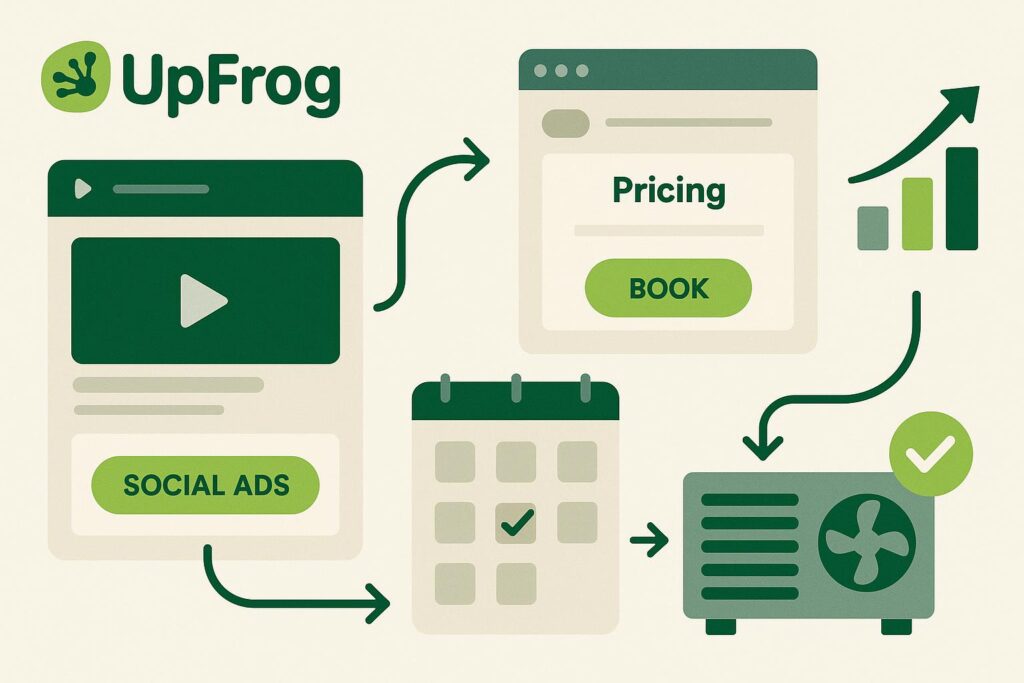
Successful HVAC social media advertising focuses on planned demand, not panic. Instead of waiting for systems to break, campaigns speak to homeowners who are already thinking about replacement — even if they haven’t said it out loud yet.
Messaging emphasizes comfort, efficiency, long-term savings, and financing options rather than discounts or urgency. Ads frame replacement as a proactive decision instead of a forced one.
Most importantly, high-performing campaigns set expectations early. They don’t hide the reality of pricing — they introduce it responsibly, creating clarity instead of friction.
Platforms That Work Best for HVAC Social Media Advertising
Facebook and Instagram remain the strongest platforms for HVAC advertising because they combine reach, targeting, and education in one environment. These platforms allow contractors to introduce replacement concepts, financing options, and seasonal messaging to homeowners who are not actively searching yet.
Video and short-form content play a supporting role by building trust and authority. Educational videos explaining system lifespan, efficiency ratings, and replacement timing help homeowners feel informed rather than sold.
Retargeting reinforces these messages, keeping the contractor top-of-mind as the homeowner moves closer to a decision.
The key is not using every platform — it’s using the right platforms with the right intent.
The Role of Pricing Transparency in HVAC Social Media Ads
HVAC pricing is one of the biggest friction points in marketing. When price is hidden completely, homeowners fill out forms without understanding the investment, leading to disappointment and low close rates.
When pricing context is introduced early — through ranges, examples, or financing framing — several things happen. Unrealistic budgets self-filter out. Serious buyers lean in. Sales conversations shift from justification to selection.
Pricing transparency does not eliminate in-home sales. It makes them more effective. Social media advertising that incorporates pricing awareness consistently produces higher-quality appointments and stronger close rates.
Who HVAC Social Media Advertising Works Best For
This approach works best for HVAC contractors who focus on system replacement and upgrades rather than repair-only volume. It favors companies that offer financing, care about long-term growth, and want predictable install demand instead of seasonal chaos.
It is especially effective for owners who want marketing that supports sales teams instead of overwhelming them. When expectations are aligned before the appointment, sales performance improves without additional pressure.
This model is not designed for contractors chasing the cheapest leads or relying exclusively on breakdown calls. It’s built for businesses that want stability, margin, and scale.
How a Revenue-Driven HVAC Social Media System Works
Every effective HVAC campaign starts with understanding the market. Pricing, financing options, install capacity, and sales process all influence how ads should be structured. Without this alignment, optimization becomes guesswork.
Campaigns are then built around replacement demand, seasonal timing, and homeowner education. Ads speak to common problems and future planning rather than immediate emergencies.
Traffic flows into conversion systems that set expectations early. These systems qualify homeowners before appointments are booked, reducing wasted time and improving sales efficiency.
Once live, optimization focuses on booked installs and sold jobs — not just lead volume. Sales feedback drives improvement, allowing campaigns to compound instead of reset.
HVAC Social Media Advertising vs Traditional HVAC Marketing
Traditional HVAC marketing is reactive. It waits for systems to fail and competes aggressively on urgency. Social media advertising, when done correctly, is proactive. It creates demand before failure and builds trust over time.
Where traditional marketing produces spikes, social media systems create consistency. Where panic marketing burns out teams, expectation-driven campaigns improve morale and close rates.
The difference isn’t creative. It’s strategy.
Why HVAC Contractors Choose This Model
HVAC contractors move to this approach when they realize that more leads do not equal more revenue. They want marketing that understands how systems are sold, how homeowners think, and how sales teams perform.
They choose systems over tactics, clarity over volume, and predictability over chaos.
Social media advertising becomes a growth engine when it’s built around revenue — not just activity.
What to Do Next
If you’re evaluating social media advertising for your HVAC business, the real question isn’t whether ads can generate leads. It’s whether your marketing system can turn attention into sold installations without burning out your team.
Learn how pricing transparency improves conversion, explore how social media advertising works across other trades, or review real-world examples of revenue-driven campaigns in action.
When HVAC social media advertising is built correctly, it doesn’t just fill the calendar.
It builds the business.